Showing posts with label writing. Show all posts

7.16.2014

Rebellion Cover Reveal

We are down to less than ONE WEEK until Extraction hits shelves!!! I'm so freaking excited for it to be out in the world. And nervous. But mostly excited.

In the meantime, in case you missed it yesterday, the cover for Rebellion, the second book in the Extraction trilogy, was revealed on the Griffin Teen facebook page!


Isn't it so pretty?! I want to frame it and put it on my wall.

Rebellion hits shelves FEBRUARY 10, 2015. I hope you'll pick up Extraction and enjoy it enough to read book 2, because Rebellion is my favorite in the trilogy so far. Just sayin'. (Of course, I'm still in the middle of writing book 3.)

Add Rebellion on Goodreads
Pre-order Extraction

1.14.2014

EXTRACTION COVER REVEAL!!!

You guys!!! I'm so ridiculously excited to finally share my cover with you. Without further ado...

....

....

....

....

....

....

....

....


---

"Welcome to Extraction testing."

Clementine has spent her whole life preparing for her sixteenth birthday, when she’ll be tested for Extraction in the hopes of being sent from the planet Kiel’s toxic Surface to the much safer Core, where people live without fear or starvation. When she proves Promising enough to be “Extracted,” she must leave without Logan, the boy she loves. Torn apart from her only sense of family, Clem promises to come back and save him from brutal Surface life.

What she finds initially in the Core is a utopia compared to the Surface—it’s free of hard labor, gun-wielding officials, and the moon's lethal acid. But life is anything but safe, and Clementine learns that the planet's leaders are planning to exterminate Surface dwellers—and that means Logan, too.

Trapped by the steel walls of the underground and the lies that keep her safe, Clementine must find a way to escape and rescue Logan and the rest of the planet. But the planet leaders don't want her running—they want her subdued.

With urgent writing, fluid dialogue, and a cast of unforgettable characters, Extraction is a page-turning, gripping read, sure to entertain lovers of Hunger Games and Ender's Game and leave them breathless for more.

---

I have to shout an enormous THANK YOU to the cover designer, James Iacobelli, who perfectly captured the feel of the story, from the gorgeous stars to the interesting swirls of color to the freckles on Clementine's face. Thanks also to Kathy Huck (my fantabulous editor), Alison Fargis (my brilliant agent), and the whole team at St. Martin's for making all of this possible.

I hope you all love the cover as much as I do, and I hope you'll check out the book when it releases on July 22, 2014! You can even pre-order it now, if you like.

PRE-ORDER AT THESE AWESOME PLACES:

3.20.2013

Slush Pile Lessons Pt. 2


For those of you who don't keep up with my non-stop 140-character fangirling statements and publishing muses on twitter, I had the wonderful opportunity to return as a slush reader for Brenda Drake's PITCH MADNESS contest this past weekend. We were Slush Zombies this time, trekking through the pile, splattering blood and guts everywhere as we searched for fabulous stories.

There were a LOT of fabulous stories. That's the hardest thing about a pitch contest like this, especially for the competing writer, because there are lots of writers to compete with. But it's also pretty dang cool because it shows how many talented writers there are in the world, and how many totally awesome books could end up on bookstore shelves someday.

(I'm looking at you and your book.)


Without further ado, I wanted to share some of the things I learned digging through the slush pile. A lot of it is similar to what I learned last time (which you can read about in detail in this post), but this time there was one big difference for me: I'm a contracted writer now, as well as a senior in college with a hefty work load, so I had a lot less time to devote to reading submissions. Which meant one very important thing: every pitch and first page I read really had to pop with brilliance on the first read-through, or I'd likely skip to the next one to keep searching for a "yes." (In case it's unclear, we Slush Zombies were the gatekeepers -- the ones deciding which pitches the team leaders would look at, and which they would never see.)

So, without further ado, here are some quick tips for those of you who find yourself on the other side of a Slush Zombie:

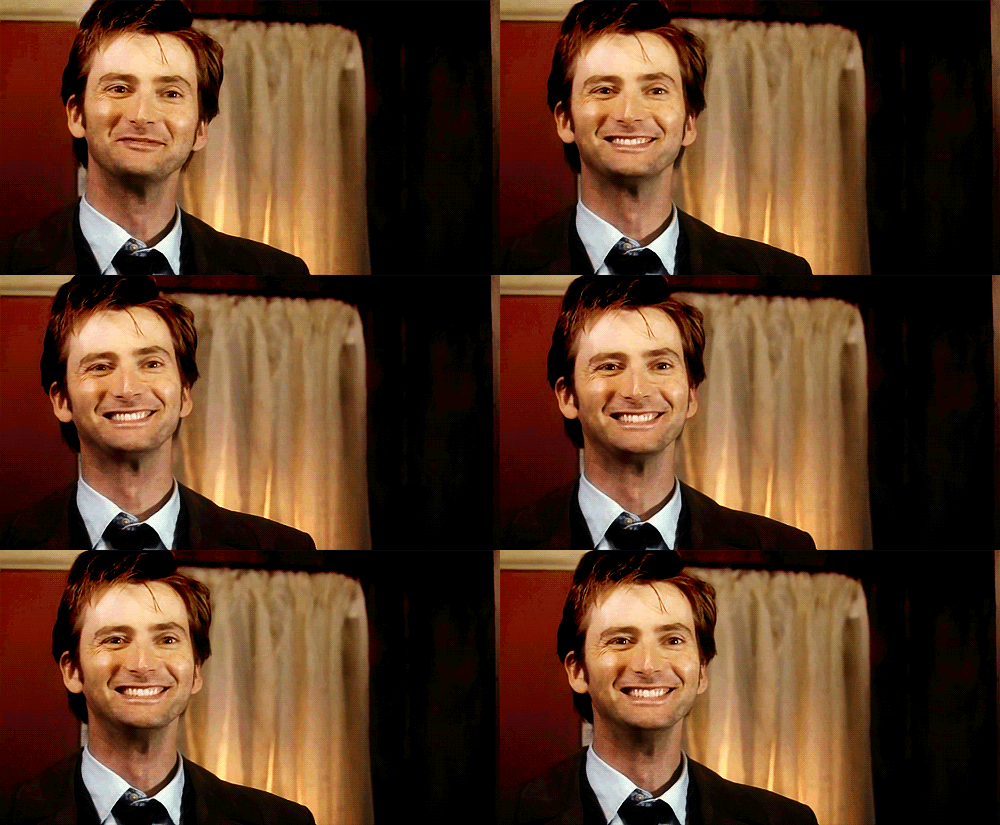
1. Stare at this beautiful man all day and be just like him:


2. Be specific in your pitch. If your novel is about a nine-hundred year old Time Lord who travels through time and space in a police box, fighting aliens who wield toilet plungers, make sure you say that instead of just: "It's a story about a time traveller." Specifics make a pitch much more interesting and go a long well in helping a story stand out.

3. Make the genre clear. When you submit to a contest like this or send a query letter to an agent, there's usually a spot where you mention what the genre is. But genre should also come across in the writing. A sci-fi should have some element in the first page that makes the reader go "oho! there may be cyborgs in this novel," or "this may be set on a spaceship," for example.

You don't want your reader uncertain whether your story is a contemporary set in NYC or a fantasy set in a Celtic-inspired world where animals talk, because such uncertainty takes away from your story. By the end of the first chapter, at the very least, the genre really should be clear.

(Bonus point: Come up with a title that sparks the genre!)

4. Double-check spelling. First impressions are really important. Yes, if your pitch is brilliant and your writing is stellar, spelling mistakes are easy to overlook, but why test fate? Triple-read your submission. Maybe even have someone else read it to double-check if you missed anything.

5. Double-check instructions. Always, always, always read the instructions for a pitch contest, or an agent's instructions about submitting a query letter. If someone asks to see your first page or first couple pages, make sure you send them! Sometimes stellar first pages can hook an agent who otherwise didn't see much of a spark in the pitch.

And, last but not least, remember to revise revise revise your pitch and first page. End the excerpt on a cliffhanger, maybe. Make the pitch and pages so brilliant, no one will have any choice but to keep reading out of curiosity.

That's all for now!

                   GO FORTH AND WRITE AND BE TOTALLY AWESOME.
                                                   KICK SOME QUERY BUTT LIKE UMBRIDGE.


---

**ADDENDUM (3/20 at 1:06pm PST): I just wanted to make sure readers understand that there are always, always, always exceptions to the tips I mentioned above. There are no rules when it comes to writing. These are suggestions based on my experience, but publishing is highly subjective. :)**

1.07.2013

Living as a Writer

Happy Monday! I hope you all had an excellent weekend.

Today I want to talk about what it's like to live as a writer. But not exactly about the part of it that you're probably thinking of. When us writers talk about living as writers, we usually talk about:

1. the number of caffeinated drinks we consume per day
2. the number of minutes hours we spend on twitter
3. the number of meals we miss
4. the number of words we did or didn't write
5. the number of times we wanted to rip our hair out or haul our laptops at a window

And so on.

And that's an important part of being a writer. Whether we're stuck in the drafting cave or the revision cave, we're bound to have days where those five things make us either unwilling or relieved to get some sleep at night.

But there's another part to living as a writer. And it's something I don't see people mention a whole lot, which makes me worried. Because it's super important.

What part? you ask.

The part where you "x" out of twitter, close your laptop, go outside, and actually live and see the world.

I think as writers, we tend to think that words are the most important thing. That any day where we don't bust out 2k or tweet at least fifty things or outline two new novel ideas is a catastrophe for our human condition.

But I disagree. I think we're missing out. Not just on parties, dates, and other social events, but on stories. The very fodder we could use to write more books. And every story doesn't have to be a book--sometimes a story can simply be a story, one that we tell our kids about or document in photos, or cling to when the going gets rough.

There's a whole world outside, after all. There are adventures to be had, in the starlight and on the streets drenched in rays of sun. And, I promise you, many of these adventures are just as good if not better than the ones we write about and read about in books.

I know writing can be a great escape. I know it's a beautiful form of expression and it can make for the best kind of day, but I think we'll become better writers if we set aside other days for more worldly endeavors.

Go for a drive, hike a trail in the wilderness, hang out at a park, watch some meteors fall, laugh with your friends at a restaurant in the evening, have a movie night.

Step away from your computer and your words for a little while. Just live.

The words won't disappear.


Some of my favorite places I've visited out in the world:


11.22.2012

Publishing is Different For Everyone

Psst. I have a secret. A good thing. Stay tuned. ;)

---------------

There's been a lot of talk on the internet lately about self-publishing vs. traditional publishing, good books vs. bad books, fast deals vs. deals years in the making, and so on. I figured it was about time I chime in with my view of things.

I don't know about you guys, but I've spent many, many hours googling author publication stories. Like, a LOT of hours. In fact, right before I wrote this blog post, I was stalking Beth Revis's website to see what her story was like, even though I'm pretty sure I've done that before. I was googling J.K. Rowling's story the other day. Mindy McGinnis (a.k.a BBC) has many wonderful stories about submission hell and successful authors over at Writer, Writer, Pants on Fire.

And you know what I've learned?

THE STORY IS DIFFERENT FOR EVERYONE.

There are many paths to success. And that's the way it should be.

Some people spend months and months and months on submission, and their book ends up selling in a major deal at auction. Others don't sell their first book, but their second is a crazy success. Others pick the self-publishing route and find readers that way.

It can take years to find success; it can take days.

That is OKAY.

This doesn't mean those whose success stories take longer are worse writers than those whose stories take less.

There are so many factors that play into publishing success. Talent is one, but others include perseverance and luck.

And yes, we all know what this means: it's possible to have limited talent but get lucky and land a publication deal, or still find a readership through a different venue.

But this also means that those with talent and perseverance can find success.

I believe you will find success, if you don't give up. 

The beauty of the publication industry is that this isn't a race. We are all searching for one thing: readers. People who love our stories. You might find them through a traditional deal or by self-publishing, but the important thing is that you find a way to get your work out there.

The way and the how are going to be different for all of us.

And that is OKAY.

It is okay if it takes you ten books to land an agent. It is okay if it takes you one.

It is okay if you receive one offer of rep. It is okay if you receive five.

It is okay if you want an agent. It is okay if you don't.

It is okay if you want to self-publish. It is okay if you don't.

If you want to put your stories out there, find a way. Find your own way - whatever way works best for you. Don't look at any one way as worse or better than another. There are good traditionally published books and there are bad ones. There are good self-published books and there are bad ones.

Make your book the best you can make it, and then pick one of the many routes to publishing. Pave your own success story. Find your readers.

And how should you respond to those who put down your path or your writing? Like THIS:


Be persistent, and you will find the readers who love your book. They are the ones who make everything worthwhile.

Repeat after David Tennant:


I believe in you.

Go forth and conquer.


9.15.2012

The Wave - a short story

I skipped school today. Instead of going to Mr. William's first period English class, I hid in the bushes while the bus drove the kids away, and then I ran to the end of the dock. It's my parents' fault; they shouldn't have bought a home so near the harbor.

I sit with my toes dangling in the water, a sketchpad in my lap. Apricot colors of sunlight peal across the waves. The boats creak in the harbor, rocking only a little, as the wind isn't harsh.

Sea lions are swimming far out. I wish they'd come closer. I couldn't risk grabbing my swimsuit in case Dad or Mom noticed it in my backpack, so all I'd be able to swim in would be my underwear.

Of course, there's no one else on the dock. The boats that are out were taken out much earlier, and most everyone else is at work.

I could always claim my underwear's a swimsuit, too. It's not like anyone could really disprove that.

Biting my lip, I pull my shirt over my head. The sea air nips at my skin in the best kind of way. I ball up my shirt and shove it into my backpack, and do the same to my shorts, smiling to myself.

A dive, and I'm under the water, letting the ocean swallow me up.

I float on my back for a couple minutes, and then decide my backpack and things will probably be safe for a bit. So, I swim farther out, past the boats toward where the sea lions were playing. I don't see them anymore. I hope they're just hiding.

The waves are a bit rockier now. I keep opening my mouth on accident and getting salt in my mouth. It's disgusting. But the sun and the wind and the water make it so totally worth it.

I'm focusing on my breaths and trying to ignore the heaviness of my arms when the current wrenches me underwater.

My eyes widen. I kick to get back to the surface, but the current is damn strong. I've read about kids who get pulled all the way down or all the way out to sea. People sometimes find their bodies.

I gasp for air, still trying to get back up. Instead, the ocean fills my mouth. Fire in my lungs.

I kick. I struggle. I try to rise instead of sink, but the water weighs me down.

Laughter and bubbles seep into my ears. Seaweed fingers latch around my wrists.

My world darkens, but I still see them. The mermaids, with golden locks of hair and eyes shooting daggers. They drag me farther down, away from the sky.

Down into black.

And I give them a new name: kidnappers.

Child stealers.

“Soon you will be one of us,” they whisper.

9.03.2012

The Lessons of Slush Pile Madness

For those of you who haven't heard (and if you haven't heard, where have you been?!), Brenda Drake is hosting a pitch contest called Pitch Madness.

The contest calls for a 35-word pitch and 150 words. Four judges will pick their top ten favorite pitches to post for the eyes of some fabulous agents. Two submission windows have already closed, but there's one more on Tuesday! (click here for all the deets)

I've had the opportunity to be one of the readers of the slush for this contest. A few other fabulous writers and I are work behind the scenes, reading all of the pitches that come in and sorting them into piles of "yes," "maybe," and "no." Then Brenda and the other three judges pick their top ten from the "yes" pile.

Let me tell you, it's hard. And scary.


I've been an entrant in contests like this before, so every time I read a pitch, I know what it feels like to be the writer. And I feel terrible when the pitch or first 150 words aren't quite strong enough or intriguing enough to earn a spot in the fated "yes" pile.

SO, I want to share some of what I've learned from the process--which is a lot. Some of these tips have already shown up on twitter. Hopefully, they'll help you guys. I don't feel terribly qualified for this. But I'll share my thoughts anyway, so even if your pitch isn't one of the finalists this time, you can fix it up so maybe it will be next time.

Here we go!


THE PITCH 

             THE INTRODUCTION - the first glimpse at what the novel is about

Your pitch should be riveting, like Robert Downey Jr.


(ladies, try not to let him distract you from finishing reading the post!)


Your pitch should show how your plot is unique.

Aim for specificity in the pitch -- 1 or 2 choice details are far better than stating something like "and then bad things happen."

The details you add enhance the voice of your pitch. A distinct voice is far more likely to stand out and capture a reader's attention.

Try to make the voice of your pitch match the voice of your novel. Remember, the pitch should show the reader what to expect. If the opening of the novel has a different feel to it, the reader may feel cheated.

Don't be too tell-y in the pitch and say things like "this is a suspenseful adventure story." Work on showing intriguing elements of the plot.

*The strongest pitches tend to not include question marks.*

Check spelling/know basic grammar. <-- It's really not that hard. Don't let something that's easy to fix weaken your pitch!

The best advice: Read through short movie descriptions or book blurbs and see what hooks you and what doesn't! Use what you learn to shape your pitch.


THE FIRST 150 WORDS

           THE NOVEL'S OPENING - the words that will make the reader want to
                                                                keep reading

The first 150 words should show some sense of genre.

They should include details of setting. Don't bog down the opening with too many details--just enough to place the character in the scene. Setting works especially well when intermingled with character action.

The action doesn't have to be radical--you don't need to open with a girl shooting her brother to capture the reader's attention. But something important should be happening to the character, or he/she should be doing something important, or you might be starting in the wrong place.

Try to write an opening that will make a reader ask a question. Then he/she is more likely to keep reading for the answer!

Don't spend all 150 words describing the character. Things like hair color, whiteness of teeth, occupation, or whether or not he/she is cool enough to wear a bowtie can wait.


The reader first needs a reason to care.

Give the reader a reason to care about the main character.

95% of the time, cutting the prologue makes the opening stronger.

If your pitch mentions two main characters, and then the first 150 introduce a different character who seems important, it can be very confusing.

If you're going to open with dialogue, make sure it's not bland. It should be eye-catching and intriguing, because the reader doesn't have any reason to care for the characters who are talking yet.

Again, check your spelling and know basic grammar!

If you ever read the first 150 words and say to yourself they're "good enough," you might want to try something different. It's easy to say words are "good enough," and it's also easy for a reader to close a book. Why not strive for the very best work you're capable of doing?

Trust your gut. Always. (Try not to ignore it.)

The best advice: Read the first page of your favorite novels, figure out why they work, and apply it to your own manuscript!


RANDOM EDITING TIPS

Look for phrases like "he saw" or "she noticed" in your manuscript and cut them. For example, "He saw Arya jump" can just be "Arya jumped." This deepens the POV.

To save words in a manuscript, remember you can replace "she sits down" with "she sits," or "we jump high up" with "we jump high."


............


That's all I've got, at least for now. I hope these tips help.

         NOW GO WRITE LIKE A BOSS.


8.29.2012

The Statue

Clearly I'm terrible at posting. So, I thought I'd leave you all with a (very) short piece of fiction I penned for a recent pinterest contest.

Side-note: you should follow my pins so I can meet more pinners.

---


(for copyright reasons, see the picture that inspired this here.)


I count the tick-tocks every time she comes to the cemetery. Every day, the apricot sun dips down, and the woman in gray comes wearing a plain wristwatch.

Tick-tock as she replaces the grave's dead flowers with fresh ones.

Tick-tock as she presses her lips to the ground.

Tick-tock as she whispers to the bones that can't hear her.

She doesn't look up at the girl made of stone. She doesn't see the tears on my cheeks, or the pleading look in my eyes.

I've counted six thousand and fifty-one ticks of her watch. My mother has never recognized me.

5.30.2012

How to Start A Novel

[Shameless Advertising: A shorter story of how I got the Call is up on my friend Michelle4Laugh's blog. You can check out it and lots of other awesome Call stories here!]

--

I've recently been toying with ideas for WIPs, waiting for one of them to grab hold of me so I could put fingers to keyboard and start writing. When it finally happened, I opened a fresh word document and started typing.

Then stopped.

Then started.

Then stopped again.


I realized I needed to rethink my process.

Now, I'm no outliner or avid researcher. I'm not a pantster, either. Generally, when an idea hits, I let it churn in my brain a little, then jot down a short query synopsis (VERY flexible for change), then start at the beginning - a very good place to start. That's exactly what I did this time, only I realized that my lack of understanding of character, place, etc. was not going to get me anywhere. So, I did some thinking, scrapped most of what I'd written for the beginning, and started over fresh. I'm much more pleased with what I've written now.

For those of you also struggling with writing those first words of a fresh manuscript, here are some tips:

1. Love the query


Unless this is your first manuscript, all of you know how horrible it is to write a query letter a short, enticing introduction to your completed novel. Use this to your advantage. Before you've even written the first sentence of the novel, craft a query you love and build the plot details of the novel around it. Not only will it help you focus the plot and make it intriguing, but you'll also have query draft 1 complete!

2. Consider your characters


Some writers (like me) are eager to dive into a novel without outlining or even knowing much about the main characters. But if you take even a couple minutes to figure out what they're like, where they come from, and what incident will upset their world can lead to a clear beginning for the story.

3. Use pictures for inspiration


Pinterest, anyone? If you haven't checked out this site already, I encourage you to do so, as it's chalk-full of fantastic images that can serve as a major source of writing inspiration. You can create boards for your novels that allow you to collect images related to location, period, and characters. A great picture can be enough to spark an awesome story. (If you're curious, you can glimpse the world of Extraction here.)

4. Be open to mistakes


Sometimes, the best way to write a novel is to barrel through even when you're stuck. Remember that the fresh manuscript is a draft; it can be revised and polished. Maybe you'll have to write three or five or twenty openings before you find one you're happy with, but write all of them. You never know what they'll lead to.

I'll leave you all with an entirely unrelated but lovely advertisement, courtesy of Game of Thrones.


Happy drafting!

5.22.2012

The Obnoxiously Long Story of How I Got An Offer

June 2, 2006. The day I sent my first query letter.

It was for an alternate history novel that took place in the Civil War era. That's all you'll ever hear about it.

Now, I was thirteen when I queried my first novel. I received a couple requests for it, which (not surprisingly) resulted in passes. But I also received encouragement from agents who knew my age and believed in a couple years my writing might be strong enough to sell. I will always be grateful for their words. Writing is what I've always loved to do, ever since I could write. The number of unfinished--and a couple finished--short stories in the journals in my closet is too high to count.

So, I set my first novel aside. I started some others and eventually settled on a fantasy for young adults. I have no idea how many revisions it went through over the couple years I worked on it. But in June of 2011 (yes, a long time later), I started querying.

From June to October, I sent out queries and landed a grand total of two requests. Beta readers had loved it--even the agents who read it admired the writing. So what was up with that?


Well, this is what I think:

A. It was a high fantasy, which few agents rep.
B. Angels and demons were involved--in a different way than in paranormal books, but their appearance in the query was probably a turn-off.

Whatever the reason, by October I decided to stop querying and set the book aside. I had simply spent too much time on it.

And a new idea was calling.

A moon.


A poisonous, giant moon looming in the sky. That's how Extraction began.

The idea came to me from a single line in a manuscript written by a dear friend of mine, the lovely Riley Redgate (who blogs over at In The Jungle). She mentioned a moon in the sky, and for some odd (but awesome) reason, I pictured it way bigger than it was actually supposed to be. And then wondered what the world would be like if the moon were poisonous.

In the summer of 2011, I wrote the first chapter for a book that involved this giant, poisonous moon. For a while, I set it aside, but in October, I was ready to dive in again. See, it was the week of my birthday (on October 7th). The idea had been developing in my head long enough that I knew I had something special, and I was determined to spit it out.

I set a goal for myself: I had until December 1st to write the first draft. I finished about seven days early.

People always say it's a good idea to step away from a manuscript before revising it, but I ignored them. I flew straight into revisions, found myself some beta readers, and had a query out January 9th.

Thereafter, I started getting rejections.

Oh my, I thought. The query had been polished and given the stamp of approval by many writer friends. What was going on?

I won a full request through a pitch contest online, so I had a feeling it was the query, not the premise or manuscript that was getting me rejections. I revised the query again. I tried a couple different versions. Still, nothing.

One day, I came across a query by a published author that inspired me to try something brand-new. I whipped up a new query and sent it out on February 13.

Reward: Partial Requests! Full Requests!


Sure, I was still getting rejections, but the requests were enough to get me excited. Finally, agents were reading my manuscript!

February 23, I got a call from an agent who had requested my full. No, this was not "the call." It was a wonderful agent who took the time to let me know he had started reading and stopped after a certain point. He explained why. He told me what was wrong with my novel and offered suggestions to fix it. And I am so glad he did. I owe a lot to him.

That evening, I started revisions. They took me a good month, as I rewrote half the manuscript.

I finished and started sending queries out again. On April 2, I received a request for revisions from another dear agent. These revisions took me about the same time, though they were of a different nature and, at least in my mind, not quite so major. Again, I was incredibly grateful for suggestions. It was clear to me by now that the manuscript I'd first queried was not anywhere near ready, but it was getting there.

Monday, May 1, the day before Insurgent's release, I deemed the manuscript ready to send out again. I resubmitted it to Dear Agent, and also to a number of others who had requested it right around that time.

me + Insurgent = happiness


The next Monday, I learned Dear Agent was passing. She had wonderful things to say, including interest in other manuscript ideas of mine, but her reason for passing (the current market) also made me realize something. Extraction was maybe not going to be the manuscript that would land me an agent.


But that was okay! I had another idea Dear Agent thought sounded intriguing, and I was eager to start writing it.

The next day, Tuesday, May 9, I was sitting in my acting class around 12:30pm PST when I noticed I had a new email. I opened it without really noticing who it was from.

I did a major double-take.

An agent--let's call her Agent 01--had finished Extraction, and not only had it made her cry, but she wanted to talk to me on the phone sometime in the next day or so. A phone call! dizhfghdgjdgl

Only, I'd had a phone call before. So, despite the fact that I audibly squealed, I didn't get my hopes up too much. I told myself it would be another call about revision suggestions.

The next day, I was actually driving when Agent 01 called. I pulled into the library parking lot as quickly as I could and answered before it went to voice mail.

Two minutes into the conversation, Agent 01 offered representation. And my world changed.


I texted my best friend right away. I drove home (I completely forgot to check the library for the book I had wanted) and let a couple others know. My parents came home, and I jumped up and down when I told them. I also sent out emails to the agents who were reading my manuscript or still had my query letter, letting them know I'd received an offer. About ten others were reading it, at the time. I gave them a week to get back to me.

The next day, I had an email from an agent who wanted to talk to me on the phone--only, it was going to be a call with her AND another agent from her agency. Intimidating, much?

I spoke to both of them the following morning. The first agent was the one I had queried, and she'd loved my manuscript, but she and the second agent (let's call her Agent 02) had decided the second had a better spot for me on her list. Agent 02 also loved my manuscript. Agent 02 offered representation.

I received two more offers before the week was up. Agents 03 and 04 were also enthusiastic. Every single one of them was professional and experienced, and all of them had small enough lists that I felt I'd receive the right amount of attention from each of them. Only one had revision ideas I wasn't quite sure about.

To put it lightly, it was a tough decision.

But in a way, it was also easy. The moment I began conversing with Agent 02, I was overwhelmed by her passion and drive. Not only did she adore Extraction, but she had her entire agency behind her. Her assistant had read it in a day. I had a built-in set of cheerleaders.

Even more than that, I felt like Agent 02 got my story more than the others, which was the most important thing. She compared parts of it to real-life events that I hadn't thought to compare it to before, but they fit. She had revision suggestions, but I agreed with them. And she wanted a sequel. I also wanted a sequel. ;)

From our first conversation, I felt Agent 02 really fought for the opportunity to represent me. I felt like she really wanted it. When it came time to decide, I went with her because she was the obvious choice for me.

Between the three manuscripts I've queried, I've sent out several hundred queries and received numerous rejections. I received twenty-six requests for my young adult sci-fi Extraction. Four offers. I accepted one of them.

I am delighted to have Alison Fargis of Stonesong as my agent. :)


5.21.2012

I Have An Agent

So, some very cool things have happened in the past week and a half.

Namely...

I HAVE AN AGENT!!!

*throws confetti everywhere*

It's official now, because I've signed the contract. See:


My favorite pen in hand.


Look! The Doctors are happy, too!


I am pleased to announce that I am represented by the lovely Alison Fargis of Stonesong. The (obnoxiously long) story of how I got here will be up tomorrow!

6.11.2011

Writing Fantasy: Creating a World Step 4

This is the fourth and final post in my "Writing Fantasy: Creating a World" series. Each step may take some time, and will likely stretch out over the course of your world-building, as new ideas spring up and mesh together.They are intended to give you a starting point if you're unsure where to begin creating a world for a fantasy novel.

My previous post, which you can find here, focused on the political structure and recent history of your world--whether kings or nobles rule your land, and whether wars have happened in recent decades. After the first three steps, you should be well on your way to illustrating your world's geography and knowing something of your world's inhabitants and what their racial relations are like. Once you've grasped at least the beginnings of those steps, feel free to move onto the final step in this series:


Step Four: Culture

In this step, it's time to flesh out how the inhabitants of your world live and interact on a daily basis. Is there a common language in your land? Are religious beliefs far-spread, or different in every region? How does each race believe your world was created? Do the poorer people act the same as those who are wealthy?

You may also want to consider the types of clothing and residences that are common in each region. Do elves wear rich robes, or thin fabrics? Do dwarves live in manor houses, or in holes in the earth?

Also, touch on the topic of magic. Are there wizards and magicians in your world? Can anyone do magic, or is it something that must be learned? What are the dangers? If you use a magic system, make sure that it doesn't make everything easy, or the challenges your characters face will not feel like challenges.

Take time considering whether there are cultural festivals in your world, and what the months and days of each year are called. Grasping the culture and tradition of your world allows for a rich story setting when you sit down to write your fantasy masterpiece. Each of the steps I've gone over so far will continue to develop as you write your story, but it is helpful to have a strong foundation before you even begin. Fantasy worlds must be complex and realistic, so don't rush the process of creating one. Patience will do you well in the end.


Now it's your turn--have you made up any languages or magic systems for your novel? How did you go about creating them?

6.09.2011

Writing Fantasy: Creating a World Step 3

This is the third post in my new "Writing Fantasy: Creating a World" series. Each step may take some time, and will likely stretch out over the course of your world-building, as new ideas spring up and mesh together.They are intended to give you a starting point if you're unsure where to begin creating a world for a fantasy novel.

My previous post, which you can find here, focused on the races of your world--the inhabitants of your planet and where they reside. After the first two steps, you should also have some idea of your world's geography, and a potential map for reference. If you've completed those steps or are struggling with the physical characteristics of your inhabitants, feel free to move on to:


Step 3: Political Structure & Recent History

Who rules your fantasy world? A king and his court? A council of nobles? Have there been wars in recent decades? Or is the land peaceful and quiet, about to be stirred by an unfortunate event?


In this step, focus on the political spectrum of your fantasy world, and consider your world's recent history. While recent history is back-story in your novel, it's important to have some sort of grasp on where your world has been and how it will now change in the course of your novel. Without change and conflict, you have no story. Does your conflict derive from exterior forces, such as armies or treacherous rulers? This is the step to begin considering such things, by understanding the atmospheric setting of your story.

Now it's your turn--what kinds of political machines rule in your fantasy land? How do you develop your world's back-story?

6.07.2011

Writing Fantasy: Creating a World Step 2

This is the second post in my new "Writing Fantasy: Creating a World" series. Each step may take some time, and will likely stretch out over the course of your world-building, as new ideas spring up and mesh together.They are intended to give you a starting point if you're unsure where to begin creating a world for a fantasy novel.

My first post, which you can find here, focused on the geography of your world--the physical characteristics of the planet. But after the first step, you should have some idea of your world's geography, and also a potential map for reference. If you're struggling with the physical characteristics, feel free to move on to:


Step Two: Peoples of the World (Races)

In this step, you should focus on who will populate your fantasy world. Are there only humans? Elves? Dwarves? Goblins? A completely new race of beings that you want to make up?

You don't need to develop the names and cultures of all of your races yet, but it's a good idea to start considering which major ones will live in your world. Whichever races you choose, it's important to figure out which parts of your world they will inhabit, and also what they look like. The climate in a particular region affects the physical characteristics of those who live there. For example, a human who lives in a snowy mountain region where there is little sun will likely have paler skin than one who resides in the desert.

You can also begin thinking about the evolution and history of your races, as this plays a part in where certain types of beings live in a particular world. Have certain races mingled with others and inter-married, creating half-breeds? You don't have to answer all of these questions now, but having an idea of what races inhabit your country will help you on your way to fully creating a fantasy world.

Now it's your turn--what types of races live in your made-up world? In what regions do they reside?

6.06.2011

Writing Fantasy: Creating a World Step 1

Writing YA fantasy has been a favorite of mine since I could write. So, I decided it would be fun (and hopefully engaging) to focus more of my blog posts on the fantasy genre. Today will mark the first post in my new series, which I have coined "Writing Fantasy: Creating a World." Highly original, I know :P

When I first sit down with the intention of creating my own world from scratch, there are a series of steps that I go through, often somewhat unconsciously. I'll be going over each step, for the next several blog posts. Each step may take some time, and will likely stretch out over the course of your world-building, as new ideas spring up and mesh together.They are intended to give those of you who are interested a starting point, if you're unsure where to begin creating a world for a fantasy novel.


Step One: Geographical Features

If you have a knack for drawing, this step might be a favorite. The very first thing I do is determine what kind of fantasy world I want to write about. A vast earth-like world similar to Tolkien's Middle Earth? A far-off volcano planet? A world covered in water save for a tiny island in the center? Pick a setting that inspires you, because you're gonna be stuck with it for an entire novel, or maybe even a trilogy/series. You don't have to develop every single geographical feature right away (after all, geography and plot need to weave together in a novel, and that often develops through the writing process). But having a starting point is essential.

Here are some examples of geographical features you might want to include in your fantasy world:
-mountains
-rivers
-oceans
-deserts
-bayous/marshes
-volcanic activity
-plains
-ice lands

Variety is good when it comes to creating the geography of a world. Also, pay attention to what types of ecosystems lie next to one another in real life, as a sense of reality is important even in fantasy. Once you have an idea of how the world looks in your head, it's often helpful to sketch it out in the form of a map. Feel free to google search or look at published fantasy books for ideas about drawing your map. Develop something that you feel comfortable using, and remember that it doesn't have to look perfect. It's just a reference that will help you when you sit down to write your story.

Now it's your turn to speak--have you ever created a map for your story? What's the first step you take when creating a fantasy world?

6.05.2011

Three-Act Structure

This past semester, I took a college course entitled Broadcast Writing and Production. Although its focus was on writing for news, television, and the screen, many of the topics touched upon are relevant to creative writing and, in particular, the writing of novels.

Every novel has structure. Whether this is pre-planned in outline form by the author or arisen out of revision work and "pantsing" the story, the structure is there. Being aware of a three-act structure beforehand can make writing a whole lot easier. The following structure is derived from a movie's three-act structure, but can (and should) be used as a guideline in novels, as well:


ACT ONE
1. Establishing scene: the first scene of a story is pivotal. It needs to include a--
2. Narrative hook: something that draws the reader in right away, whether it be dialogue, action, or interesting details.
3. Introduction of protagonist: the reader should meet the main character(s) ASAP, as he/she/they should drive the story.
4. Introduction of antagonist: who or what is the protagonist up against? This should arise ASAP, too.
5. Introduction of problem: if a story has no conflict, then it is not a story. A conflict should exist from the beginning, though the protagonist may not be immediately aware of it.
6. Complication leads protagonist to confront problem and take on antagonist

ACT TWO
1. Aftermath of complication: The protag may defeat the antag, but it is not a complete victory.
2. Back-story for action: This is when it is best to bring character histories into play, through the action and complications that arise in the story.
3. B-storyline(s) developed: Romantic and other sub-plots of the story come into play.
4. Antagonist developed: The reader learns more about the antagonist's back-story. Evil plotting may ensue.
5. Another complication overcomes protagonist who seems defeated by problem and antagonist

ACT THREE
1. Preparation for climax: The protag begins to realize the weaknesses of the antag, heading towards a way of defeating the antag and the problem.
2. Resolution of sub-plots: Tie-up all loose ends!
3. Climax: Make it epic.
4. Epilogue


Happy Sunday!
Stephanie

6.02.2011

The Dilemma of POV

One of the first things most authors decide on before beginning a novel, short story, or poem is the point-of-view the work will be written in. However, I have come across a couple people who never heard the specific names of the various POVs, or knew why some might be considered "easier" than others.

Today, I will go over the three most common POVs used by writers, provide examples from published works, and mention some pros and cons of each.

First Person
In this POV, the narrator of the story is one of the characters involved in the plot, whether minor or major. Words like "I" and "me" are used to describe to describe the narrator's viewpoint. This is the most limiting POV, because it restricts all narration, thought, and bias to one character. However, it can also strengthen the bond between reader and character, because the reader will get to know the narrator so well. Here's an example from The Hunger Games by Suzanne Collins:

As we walk, I glance over my shoulder at Gale's face,
still smoldering underneath his stony expression.
His rages seem pointless to me, although I never say so.


Third Person, Limited
In this POV, the narrator only reveals the emotions and interior thoughts of one character, while relaying only external behaviors of the others. This makes it more similar to First Person, but allows for more freedom because aspects of the story not related to the main character can still be illustrated.
Words like "he," "she," and "they" are used to describe the action in the story. Here's an example from Fall of a Kingdom by Hilari Bell:

Jiaan wondered uneasily which of the commander's enemies
had bribed the priests to say it. And why.
No, he didn't envy his half sister.
Even if she was a silly, spoiled she-bitch.


Third Person, Omniscient
In this POV, the narrator is considered "all-knowing." This means that the narrator already knows how the story will end, what conflicts will happen along the way, and also what every character is feeling. Therefore, multiple viewpoints are available to the reader, and the author has the most freedom concerning how he or she wants to explain an event. The downside is that the author runs the risk of distancing the reader from the characters too much.
Words like "he," "she," and "they" are used to describe the action in the story. An example from a specific moment in the story would look very much like Third Person, Limited, while on overview would illustrate how multiple viewpoints are touched upon.


It's important to note that POVs can always be tampered with. There are many books where, for example, 3rd person limited is used, but each chapter is devoted to a different character's perspective. As long as it's not confusing for the reader, choosing a POV is just a guideline.

Happy writing,
Stephanie

5.30.2011

Pressing "Delete" on Back-story

It's been said before, but I'll say it again. Revisions are crazy hard.

Not so much the grammatical stuff--that just takes patience.

Not even the editing of plot--thinking through the arc of your story and realizing parts of it are crap or could really be a whole lot better. Maybe it takes a while, but in the end it's easy. Because we know what's crap and what's pristine and glorious. Even if we push it to the back of our brains for awhile and convince ourselves otherwise, we always know when something isn't working. Eventually.

So, no, it's not that. The hardest part is sitting down in front of your computer or a printed manuscript, setting your hands on the keyboard or firmly clasped around a pen, and pressing "delete" when you still love what you've done. Scratching out half the words. Looking at your work and realizing that though it isn't bad (maybe it's even really good!), it doesn't fit within the context of the story. That it's not really necessary to the complications and resolution; it's just back-story.

I had to do this, recently. My love for the back-story had me ignoring how unnecessary it was to the actual plot, until a wonderful beta partner snapped me out of it. All 70 pages, gone. Vanished.

But I've realized that it's better this way. It wasn't that the back-story was bad--really, it was pretty well-written. It was just wasn't necessary. That doesn't mean parts of it never happened, because all characters have back-story. It just means a reader won't get to see it.

But that's okay. I would be happy sharing only pieces of this world in my head with readers. My novel, minus those 70-odd pages, is enough.

5.21.2011

On Naming Characters

When developing an idea for a novel, one of the first things that comes to mind is the main character(s). Boy or girl? Fearless or hesitant? Smart or dim-witted? Thrust into a heroic position, or steps into it willingly? Such attributes will drive the story, for the characters make decisions based on their characteristics.

Once the attributes are figured it (or maybe even before), a big question becomes: what should I name these characters?

You have your standard names, of course: Tom, Nancy, Jennifer, and so on. You also have your make-believe names which often reside in fantasy novels. But most names begin somewhere. Most have an origin, and most have a meaning. Therefore, this meaning is something author's can consider when naming characters, to add a layer of depth to personality and purpose within the novel.

An example that instantly comes to mind is Suzanne Collin's The Hunger Games. Peeta Mellark, the Boy with the Bread, is named after peeta bread. Cato, the District 2 tribute, is named for a Roman politician and general who wrote the first history of Rome. Every single character name has a meaning or association that fits its character and adds a level of interest.

Characters in our novels have history, but so do their names. Whether it be a specific meaning or a relation to another person or object, choosing the right name is essential for a piece of fiction. And looking up etymology (name meanings) can be really fun for the readers, too!

So even if there's a name you want to use just because it sounds cool or seems to fit a character, considering researching the name's meaning and history. Make sure the etymology fits with your view of the character, and it will add an extra dimension to your characters and story!

Have a great weekend everyone,
Stephanie